
Delving into Commercial real estate tax strategies opens a world of financial opportunities for property owners and investors alike. Understanding the intricacies of tax benefits in this sector can pave the way for smarter investment choices and increased profitability.
From tax deductions and depreciation to 1031 exchanges, there are numerous avenues available to enhance your financial standing in commercial real estate. By exploring these strategies, investors can optimize their returns and navigate the complexities of tax regulations effectively.
Tax Benefits in Commercial Real Estate
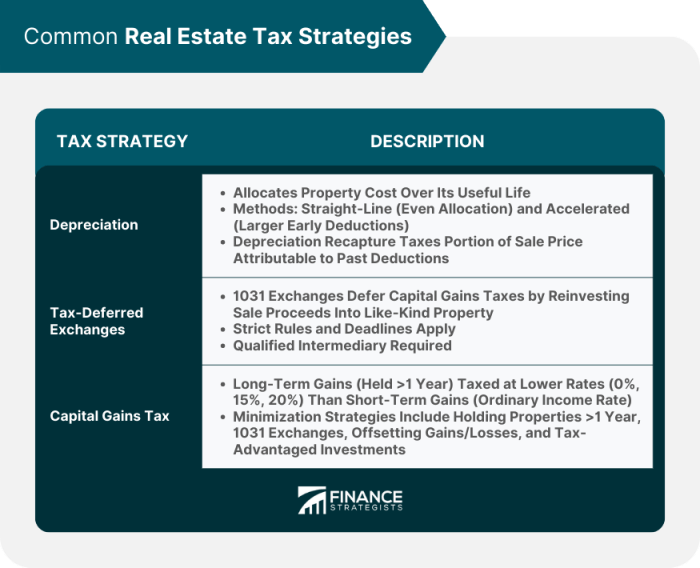
Investing in commercial real estate can provide significant tax advantages that can enhance overall returns on investment. Understanding these benefits is crucial for property owners and investors aiming to optimize their financial strategy. Various tax deductions, the impact of depreciation, and the utility of 1031 exchanges are vital components of the tax landscape in commercial real estate.
Tax Deductions for Commercial Property Owners
Commercial property owners enjoy a variety of tax deductions that can effectively reduce their taxable income. Some key deductions include:
- Mortgage Interest Deduction: The interest paid on loans used to finance the property is fully deductible, allowing owners to reduce their taxable income significantly.
- Property Depreciation: Owners can deduct the cost of the property over its useful life, providing a substantial yearly tax benefit.
- Operating Expenses: Expenses related to management, maintenance, and utilities can be deducted as necessary costs incurred in running the property.
- Improvements and Repairs: Costs for major improvements may be depreciated over time, while minor repairs can be deducted in the year they are incurred.
These deductions can lead to considerable tax savings, enhancing the overall profitability of the investment.
Impact of Depreciation on Tax Liabilities
Depreciation is a key tax strategy for commercial real estate investors that allows them to recover the cost of their property over time, which can significantly lower taxable income. Properties are typically depreciated over a 39-year period for commercial real estate.
The annual depreciation deduction is calculated using the formula: Annual Depreciation = (Cost of Property – Land Value) / Useful Life.
For example, if a commercial property is purchased for $1,000,000, with the land valued at $200,000, the depreciable basis is $800,000. Dividing this by 39 years results in an annual depreciation deduction of approximately $20,513. This deduction directly reduces taxable income, thus decreasing tax liabilities and improving cash flow.
Implications of 1031 Exchanges
A 1031 exchange, named after Section 1031 of the Internal Revenue Code, allows property owners to defer capital gains taxes when they sell a property and reinvest the proceeds into another similar property. This strategy can be powerful for commercial real estate investors looking to upgrade their investments without incurring immediate tax liabilities.To qualify for a 1031 exchange, the property sold must be an investment or business property.
Importantly, the reinvested property must be of equal or greater value, and strict timelines must be adhered to during the exchange process. This method provides a mechanism for continuous growth in the real estate portfolio without the obstacle of significant tax payments at each sale.In summary, understanding tax benefits, including deductions, depreciation, and the strategic use of 1031 exchanges, can provide commercial property owners with a robust framework for optimizing their investments and enhancing their financial outcomes.
Strategies for Real Estate Investment
Real estate investment can be a powerful tool for building wealth and optimizing tax savings. Understanding and implementing effective tax strategies can significantly enhance the financial performance of real estate portfolios. Investors can leverage various methods to maximize tax benefits while navigating the complexities of tax codes and regulations.
Optimizing Tax Savings through Real Estate Investing
Investors can optimize their tax savings through several strategic methods. Primarily, leveraging depreciation allows property owners to deduct a portion of the property’s value over time, resulting in reduced taxable income. Additionally, utilizing 1031 exchanges enables investors to defer capital gains taxes on the sale of one property when purchasing another, effectively reinvesting their returns without immediate tax implications. Another critical strategy is the use of entity structuring.
By forming limited liability companies (LLCs) or partnerships, investors can limit personal liability while also taking advantage of pass-through taxation, which can further reduce their overall tax burden. Investors must also be aware of tax deductions related to mortgage interest, property taxes, and operational expenses, which can contribute to significant savings when properly documented and claimed.
Comparison of Tax Strategies for Residential versus Commercial Properties
The tax strategies employed in residential and commercial real estate can differ significantly due to the varying nature of the properties and their associated tax implications. Below is a comparison of key strategies for each type:
Residential Properties
Owners can take advantage of the mortgage interest deduction, which is often a substantial expense for homeowners.
Depreciation can be calculated over 27.5 years, allowing for a gradual reduction of taxable income.
There are specific tax credits available for first-time homebuyers and energy-efficient home improvements.
Commercial Properties
Commercial property owners typically can claim depreciation over 39 years, which can be a longer financial commitment but allows for higher deductions in the long run.
The 1031 exchange is particularly beneficial in commercial real estate, enabling significant capital gains tax deferral.
Opportunities for cost segregation studies can lead to accelerated depreciation schedules, allowing owners to write off certain components of the property much faster than the standard timelines.
Tax Credits for Green Real Estate Developments
The growing emphasis on sustainability has led to various tax credits and incentives for green real estate developments. Here’s a list of notable credits available for properties that meet environmentally friendly standards:
Investment Tax Credit (ITC)
This credit allows property owners to deduct a percentage of the investment cost for solar energy systems from their federal taxes.
Energy-Efficient Commercial Buildings Deduction (Section 179D)
This provision provides tax deductions for energy-efficient improvements made to commercial buildings.
Residential Energy Efficiency Property Credit
Homeowners can receive a credit for qualifying energy-efficient improvements, including insulation, windows, and HVAC systems.
State and Local Incentives
Many states offer additional credits for green building, including grants and low-interest loans to encourage sustainable practices.These credits not only provide financial benefits but also contribute to the broader goal of sustainability in the real estate sector. Engaging with these opportunities can enhance the appeal and marketability of properties while optimizing their financial performance.
Navigating Real Estate Transactions
The landscape of commercial real estate transactions is intricate, with many moving parts that can significantly impact tax liabilities. Understanding these elements can lead to substantial tax savings for investors. Whether it’s leveraging the expertise of real estate agents or keeping precise records of expenses, each step is crucial in optimizing tax advantages.
Role of Real Estate Agents in Maximizing Tax Advantages
Real estate agents play a vital role in helping clients navigate the complexities of commercial transactions, which directly influence tax outcomes. They not only assist in negotiating favorable purchase agreements but also provide valuable insights into potential tax benefits available to investors. Experienced agents understand local tax laws and can identify incentives such as tax credits, depreciation opportunities, and exemptions that clients may qualify for.
They can also guide clients through the process of property valuation and help in structuring deals to maximize tax efficiency, ensuring that every financial aspect is aligned with the client’s long-term investment strategy.
Documenting Expenses and Tax Deductions During Commercial Construction
Accurate documentation of expenses during commercial construction is essential for claiming tax deductions. Keeping thorough records not only supports claims but also prepares investors for potential audits. Important steps include:
- Maintain detailed receipts for all construction-related expenditures, including labor, materials, and permits.
- Utilize accounting software or spreadsheets to categorize and track expenses systematically.
- Document any changes or challenges encountered during construction, as these can impact deductions.
- Consult with tax advisors to ensure that all eligible deductions, such as depreciation and operational costs, are identified and claimed.
Proper documentation establishes credibility and can yield significant tax advantages, ultimately enhancing the overall return on investment.
Common Pitfalls in Real Estate Foreclosures from a Tax Perspective
Foreclosures can present unique challenges related to tax liabilities that investors must navigate wisely. Some common pitfalls include:
- Misunderstanding the tax implications of forgiven debt in foreclosure, which may be treated as taxable income.
- Failing to file necessary paperwork, such as IRS Form 1099-C, which reports cancellation of debt income.
- Overlooking deductions for losses related to foreclosure, such as repairs or legal fees, which can offset taxable gains.
- Not considering the impact of state-specific tax laws, which may differ significantly from federal regulations.
Recognizing these pitfalls allows investors to make informed decisions and minimize tax exposure during the foreclosure process.
Final Conclusion
In summary, mastering Commercial real estate tax strategies is essential for anyone looking to thrive in the competitive landscape of real estate investment. By leveraging tax benefits and understanding available strategies, investors can not only protect their capital but also maximize their financial potential in the long run.
FAQ Summary
What are the main tax benefits of commercial real estate?
The primary tax benefits include depreciation, tax deductions for expenses, and the potential for 1031 exchanges, which allow deferral of capital gains taxes.
How can I document tax deductions for my commercial property?
It’s important to maintain detailed records of all expenses, including receipts and invoices, and to organize them by category for easy reference during tax preparation.
Are there specific tax credits for eco-friendly developments?
Yes, there are various federal and state tax credits available that incentivize green building practices, such as energy efficiency improvements and renewable energy installations.
What pitfalls should I avoid in real estate foreclosures from a tax standpoint?
Common pitfalls include failing to understand the tax implications of cancellation of debt income and neglecting to document losses correctly, which can affect overall tax liability.
How do tax strategies differ for residential and commercial properties?
Commercial properties generally offer more tax benefits, such as larger depreciation deductions and different financing options, whereas residential properties have more limited tax incentives.


